Geography & Climate
Industry
Snapshot | Economy/Cost of
Living
Education
| Recreation
& Entertainment | Transportation
History | Suggested
Reading List
 Divided by the Cascade Mountain range, Washington is a land of contrasts. Western
Washington is characterized by a mild marine climate, while the eastern part of the state
is high-desert country.
Divided by the Cascade Mountain range, Washington is a land of contrasts. Western
Washington is characterized by a mild marine climate, while the eastern part of the state
is high-desert country.
Despite the claim in Sleepless in Seattle, it really does not
rain nine months a year in Puget Sound country. While the average total rainfall is 36
inches, most of the rain falls between October and April, heavy rainfall is rare, and the
sun really does shine frequently. Average temperatures range from highs of 75 degrees
(23.9 c) in mid-summer to lows of 26 degrees (-3.3 c) in January.
East of the Cascades, irrigation transforms the desert landscape, making it home to the
state's major agricultural region. Average temperatures in eastern Washington range from
summer highs of 89 degrees (31.6 c) to winter lows of 19 degrees (-7.2 c), and the
average annual precipitation is only 18 inches (46.2 cm).
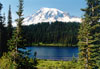
The western Washington skyline is dominated by Mount Rainier, which
towers 14,410 feet (4,395 m) above sea level only miles away, and the other jagged peaks
of the Cascade Mountains. In the west beyond Puget Sound the majestic Olympic Mountains
are sentinels towering over one of the world's greatest old-growth forests.
Related Resources:
Back to Destination Seattle
|